
Advertisers on Momba Media's In-Taxi TV network choose between two creative formats: a 15-second video banner or a static 1920 × 1080 banner. Both sit in exactly the same slot, and Momba Media recommends video for most campaigns. The right pick comes down to your message, your timeline, and how a seated commuter takes in digital screen advertising inside a moving taxi.
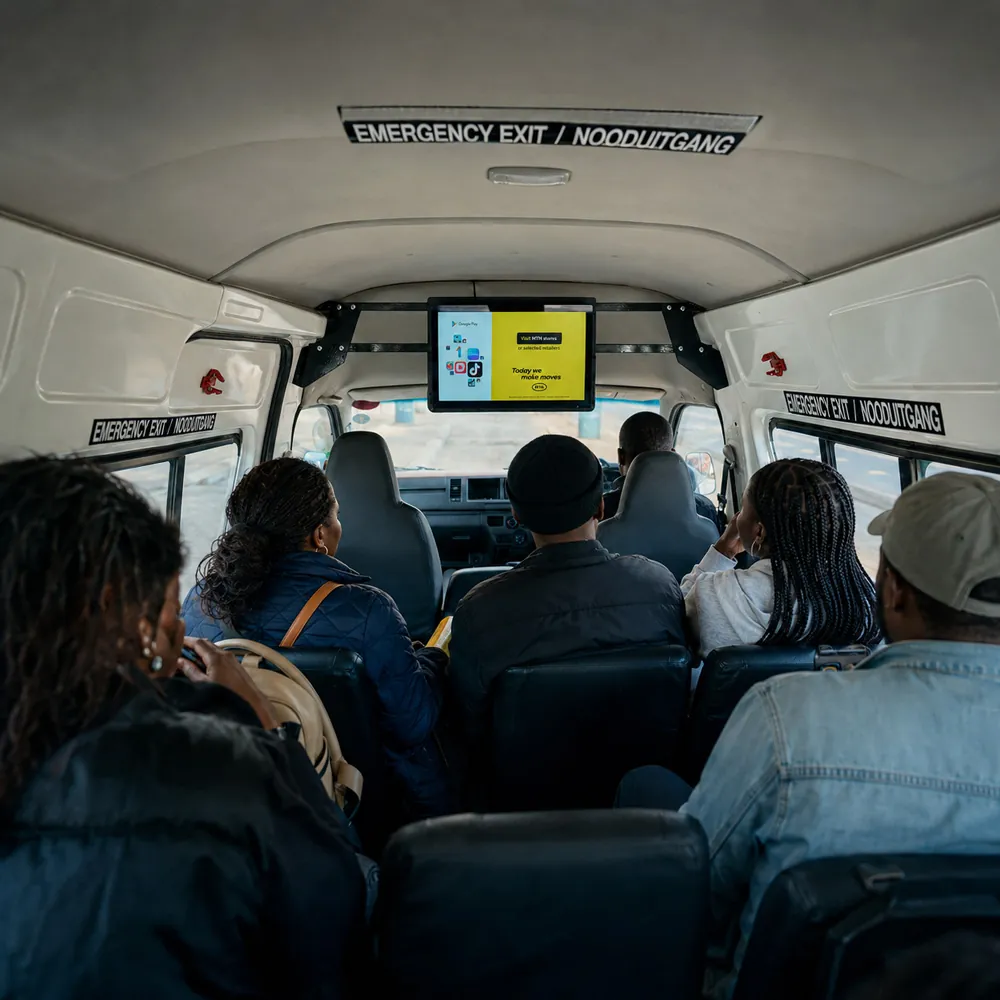
Advertising on this network means your creative playing on an HD screen inside the passenger space of a minibus taxi. It is not branding wrapped on the outside of the vehicle, which is a different product with different economics. Momba Media operates 400 screens across eight of South Africa's nine provinces as official Media Partner of Straat Africa, 22-inch in seven provinces and 17-inch in the Western Cape.
Every advertiser books the same thing: a 15-second slot inside a 180-second loop of 12 slots, running 18 hours a day, seven days a week. That works out at 4,320 slots per screen per day. The only real creative decision is what you put in that slot, a video banner or a static banner.
A video banner is a 15-second 16:9 MP4, up to 300MB, that plays in full each time your slot comes round in the loop. Momba Media does not produce video in-house. Nkiyase Mondlana Mbatha, Momba Media's founder, is clear on where that sits:
In terms of the production of the video, we normally request the client to actually produce the video on their side.
Brands that need help are referred to production partners.
Video earns its place when the message carries a story or a feeling rather than an instruction. Asked whether there are goals where she would steer a client away from it, Mbatha does not hedge. Her view:
I believe that a message that is portrayed through a video has more impact than the message that normally is portrayed via static. That's my belief and my take. But of course, it's up to the client because sometimes they will prefer static.
The recurring issue is length. An existing TV ad that already runs 15 seconds can play as it is, with only the dimensions changed, but a 30-second cut has to be re-edited, so Momba Media flags the 15-second slot in writing before a client spends money producing a longer version. Whatever the source, the message must be clear and straight to the point, so passengers can read it, understand it and act on it.
A static banner is a single 1920 × 1080 HD image that holds the screen for the full 15 seconds. Momba Media's own creative team can build static artwork when a client asks, so it needs one resource rather than the multiple resources and longer lead time a video involves.
The clearest case for static came from the IEC. As Mbatha describes it:
The IEC campaign was static instead of a video. And the reason is because they wanted, for 15 seconds, a message that is written so that the passengers or the audience can be able to read and understand.
The advert closed with a call to action pointing commuters to where they could register to vote.
That campaign also showed static's other strength. Voter registration dates shifted after the flight had already launched, and the IEC asked for the change to be made immediately. A fresh image can be redrawn and back in the loop far faster than a video can be re-edited and re-approved.
Not sure yet which format suits your message? Tell us what you need commuters to do and we will tell you straight.
Ask Which Format FitsMomba Media recommends video for most campaigns, because movement holds a passenger's attention harder than a still image. Static earns its place when a client can't supply a video, or when the message has to be read and acted on. If you want a commuter to read something and act on it, a date, a number, a place to go, static is the safer pick. The words stay still for the full 15 seconds. If you want them to feel something about a brand, video does more with the same slot.
Recall on this network comes from repetition more than from any single play. The Legal Aid SA campaign ran across 57 taxis for 29 days and 12,499 completed trips. It delivered 1,785,240 ad plays and 1,358,402 impressions at an average frequency of 10.45 views per trip, reaching 129,948 unique people. Morning commute was the strongest window at 540,408 impressions, ahead of evening at 399,852 and afternoon at 332,609.
On cost and speed, static is usually the lighter lift, because one designer can produce it, Momba Media's in-house team included, rather than a production chain. Video asks more of your budget and calendar up front, and is slower to change once it is live.
Both formats occupy the same 15-second slot in the same 180-second loop.
| Video banners | Static banners | |
|---|---|---|
| Format | 15-second 16:9 MP4, 300MB max | 1920 × 1080 HD image, full 15 seconds |
| Attention | Movement draws the eye; must still work with sound off | Message holds still long enough to be read and remembered |
| Message type suited | Brand stories, launches, emotive or narrative messaging | Instructions, dates, calls to action, anything read-and-act |
| Production effort | Client-produced or via referred partners; multiple resources | Supplied by the client or built by Momba Media's in-house creative team; one resource |
| Flexibility mid-campaign | Changes mean a re-edit and re-approval | Artwork can be redrawn and returned to the loop quickly |
| Favoured when | You have the asset, the budget and a story to tell | Your timeline is tight, or the audience must read and act |
Start with the single thing you need a commuter to walk away with. One message, one visual idea, one action, because 15 seconds in a moving vehicle will not carry more than that.
Running both is a reasonable plan, not a hedge. Brands often pair a video banner for the brand story with static versions carrying the offer, the dates or the local detail. Momba Media's own demographic research by area guides which language versions go on which routes. As Mbatha puts it:
We also have done our own research in terms of the demographics in various areas, and that's how we are able to assist our clients.
Run through this before you brief
Tick off each one as you go.
No, and we tell clients before they spend the money. "We request our clients to re-edit the video because 15 seconds has more impact than 30 seconds," says Nkiyase Mondlana Mbatha, Momba Media's founder. "Hence, we decided that our slots will be 15 seconds instead of 30 seconds for impact purposes." Every slot in the 180-second loop is 15 seconds, so a longer cut has to be re-edited down to one message and one action.
Do not build your creative on the assumption that anyone hears it. A minibus taxi is a loud environment and the screen sits a few metres from the passenger, so we ask that every advert works muted. That means large type, a single clear message, and no punchline that only lands with audio.
Yes, and multiple language versions across different routes are straightforward with either format. We advise on language using our own research into the demographics of specific advertising areas, so the version playing on a route suits the people on it. Static makes multilingual versions particularly easy, since each one is a fresh HD artwork rather than a fresh edit.
Every advert has to clear the ARB Code of Advertising Practice before it enters the loop, and scheduling is then planned around your chosen provinces and routes. Once the final file reaches us, we respond within two hours and need about two hours more to upload it, so approved creative can be live the same working day. Making the creative is the slower part: static needs one designer, and our in-house team can produce it if you ask, while video depends on your own production timeline, so speak to us early and we will confirm realistic dates for your flight.
Momba Media plans, schedules and installs video banner advertising across a managed out-of-home screen network reaching commuters throughout South Africa.
See video bannersA fast, cost-effective outdoor advertising format built for instant recall on HD screens inside minibus taxis across South Africa.
See static banners
Everywhere Your Audience Goes.
Connecting Brands with South Africa's Workforce. Every Journey. Every Day.
Add to preferred sources
A quick stop for cookies
We use cookies to see how people find our site and which pages help them, so we can keep improving it. Accept them, or decline and carry on browsing. Your call. Cookie policy
Brochure · PDF
Tell us who you are and the brochure is yours to download straight away.