
Static banner advertising on Momba Media's In-Taxi TV network is a custom still-image ad that plays inside the 3-minute loop on HD screens fitted in 400 minibus taxis across South Africa. Brands supply their own 1920 x 1080 artwork, and once it's approved it goes straight into rotation alongside video ads, each getting the same 15-second slot. It suits a brand with one clear message to land, rather than a 15-second story to tell. It's the quicker route onto the network for anyone who hasn't budgeted for a video shoot.
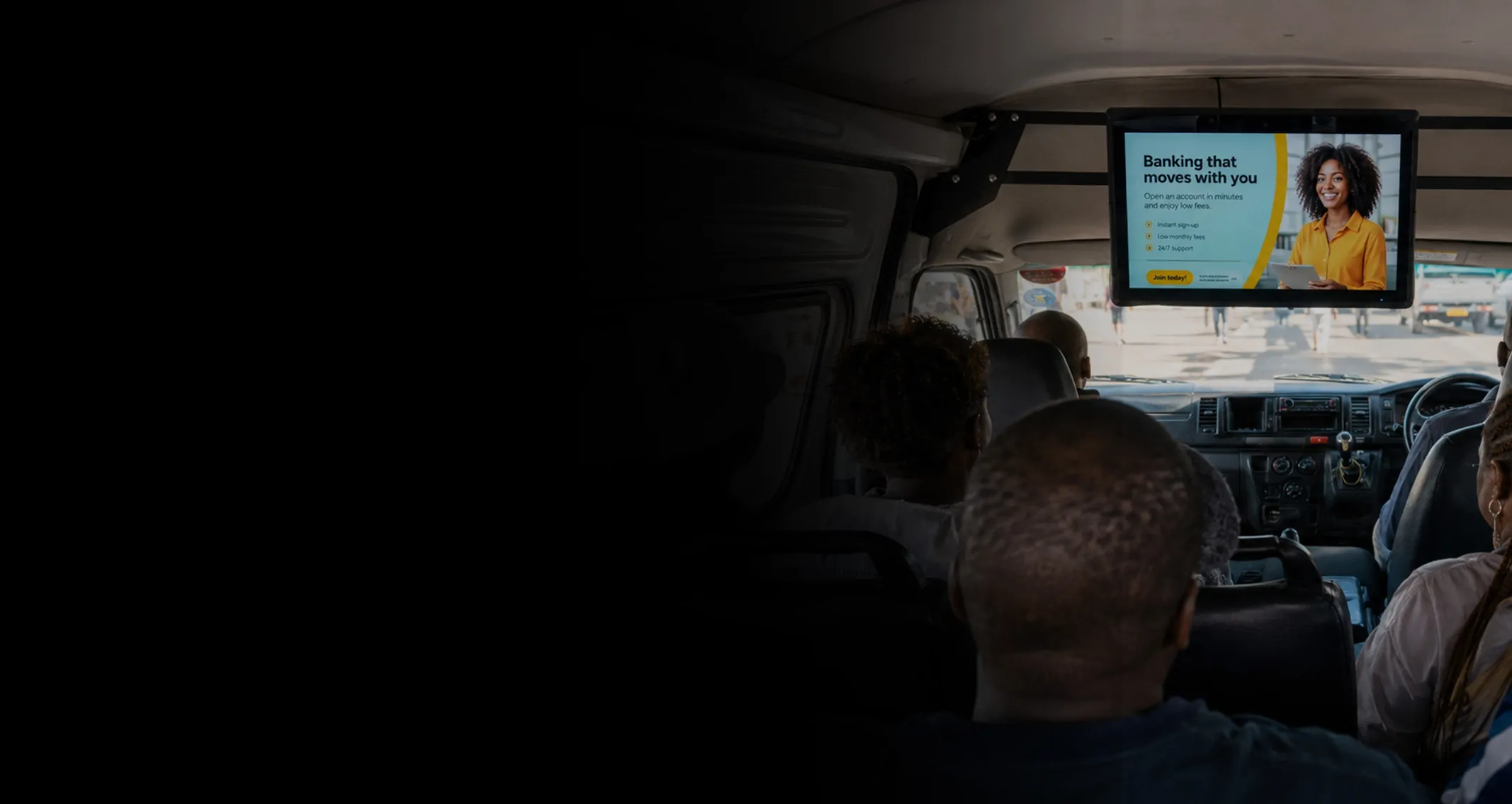
On Momba Media's in-taxi screens, a static banner is a single HD image, 1920 x 1080 pixels. It holds the screen for a fixed 15-second slot inside the network's 3-minute content loop. That loop carries 12 slots in total, so a static banner sits alongside video ads in the same rotation, reaching every passenger who boards during that journey.
This is not the same as the branding wrapped around the outside of a taxi. Static banners play on the HD screen fitted inside the passenger space, in front of someone seated and facing the screen for the length of their trip. They're not painted on the bodywork for people to glance at from the pavement.
A custom HD still image (1920 x 1080) that runs for a 15-second slot inside the 3-minute in-taxi screen loop. Review and upload typically takes around four hours from submitted artwork to live on screen. Best suited to a brand with one message to land, a call to action to deliver, or no video yet produced.
Once artwork lands, Momba Media reviews it within two hours to check it's ready for the screen, sized correctly and compliant with the ARB Code of Advertising Practice. A second two-hour window covers uploading the approved creative into the loop and scheduling it live across the chosen routes. That means a brand can go from finished artwork to live on screen in a single working day.
Brands without a finished static banner aren't left to work it out alone. Momba Media's team will flag early if a logo, colour or layout won't read well on a screen passengers are seeing from a few metres inside a moving taxi. That check happens before anything ever reaches the loop.
Momba Media plans every static banner campaign around the provinces and routes that match a brand's audience and objectives. That covers eight of South Africa's nine provinces through the same screen network in 400 taxis used for video campaigns. That targeting sits inside the same understand-plan-schedule process used across the network, so a static banner booking gets the same route-level thinking as any other format.
Repetition is what makes a still image work on this screen. In a taxi travelling for around 15 minutes, a seated passenger will see the same ad at least five times before they reach their stop. That's the guaranteed exposure that sets this medium apart from formats where an ad is glimpsed once and gone.
Have one message to land and no video ready yet? We can plan the provinces and routes for it with you.
Plan a Static CampaignMomba Media recommends video for the clear majority of campaigns, around 99.9% of the time, because a moving image tends to hold a passenger's attention harder than a still one. Static banners earn their place when a client genuinely can't produce a video in time, or when the message itself works better read than watched.
A voter-registration campaign is the clearest example of static done right. The static banner carried a direct call on South Africans to register to vote, ending with a web address where passengers could find out more. The message needed to be read and absorbed rather than performed in 15 seconds of motion.
Comparing static and video banners on the In-Taxi TV network
| Static Banner | Video Banner | |
|---|---|---|
| Production effort | A single HD image, 1920 x 1080, no video shoot required | 15-second video produced and edited to broadcast spec |
| Message style | One message, text-led, strong call to action | Motion and sound-off storytelling across 15 seconds |
| Best fit | No video ready yet, or an informational message like a registration drive | Brand storytelling, product demos, campaigns that need movement to land |
| Slot length | 15 seconds | 15 seconds |
The most common mistake is lifting an existing print or billboard ad straight onto the screen without checking it actually works there. A design that holds up on a poster can lose all its impact at in-taxi screen size. Brand colours and layout need a proper check against the screen before anything goes live, not after.
Static banners suit a brand with one message, a call to action, and no video yet produced. They're a weaker fit for a brand that needs to show a product in use, tell a story, or lean on sound. A moving image simply holds attention harder in this environment.
Before you book, check this
Tick off each one as you go.
No. The format is built to work with the sound off. Everything has to land through the image alone: big type, one message, and a call to action that doesn't depend on being heard.
Yes. Both formats run in the same 3-minute loop on the same 15-second slot length. A brand can mix static and video creative across a single campaign if that suits the message better at different stages.
Because delivery is fully digital, there are no print costs involved, so a client just sends the updated file and it replaces the old version in the loop. It's worth flagging early in planning if a change is likely, so the swap can be scheduled without a gap in the campaign.
Yes. Every static banner is reviewed within two hours of being submitted, checked against the ARB Code of Advertising Practice and for how it will actually read on the screen. It's then uploaded and scheduled into the loop.
Think in terms of a flight, not a single short burst. Recall builds through repetition. A seated passenger sees the same ad at least five times in just one 15-minute journey, and that frequency needs sustained time on screen rather than a one-province, one-month test to show what it can do.
A straight comparison of both creative formats on the In-Taxi TV network, so you can brief the right one first time.
Compare the formatsMomba Media plans, schedules and installs video banner advertising across a managed out-of-home screen network reaching commuters throughout South Africa.
See video banners
Everywhere Your Audience Goes.
Connecting Brands with South Africa's Workforce. Every Journey. Every Day.
Add to preferred sources
A quick stop for cookies
We use cookies to see how people find our site and which pages help them, so we can keep improving it. Accept them, or decline and carry on browsing. Your call. Cookie policy
Brochure · PDF
Tell us who you are and the brochure is yours to download straight away.