
In-taxi advertising puts HD video and static ads on screens fitted inside a taxi, playing through a passenger's journey rather than sitting on the outside bodywork. Momba Media operates this network across 400 taxis in eight of South Africa's nine provinces, working in partnership with Straat Africa. Book a campaign and you get scheduled airtime in the daily loop, with route and province selection built around your budget and objective. You also get a report at the end showing who actually saw your ad and how often.
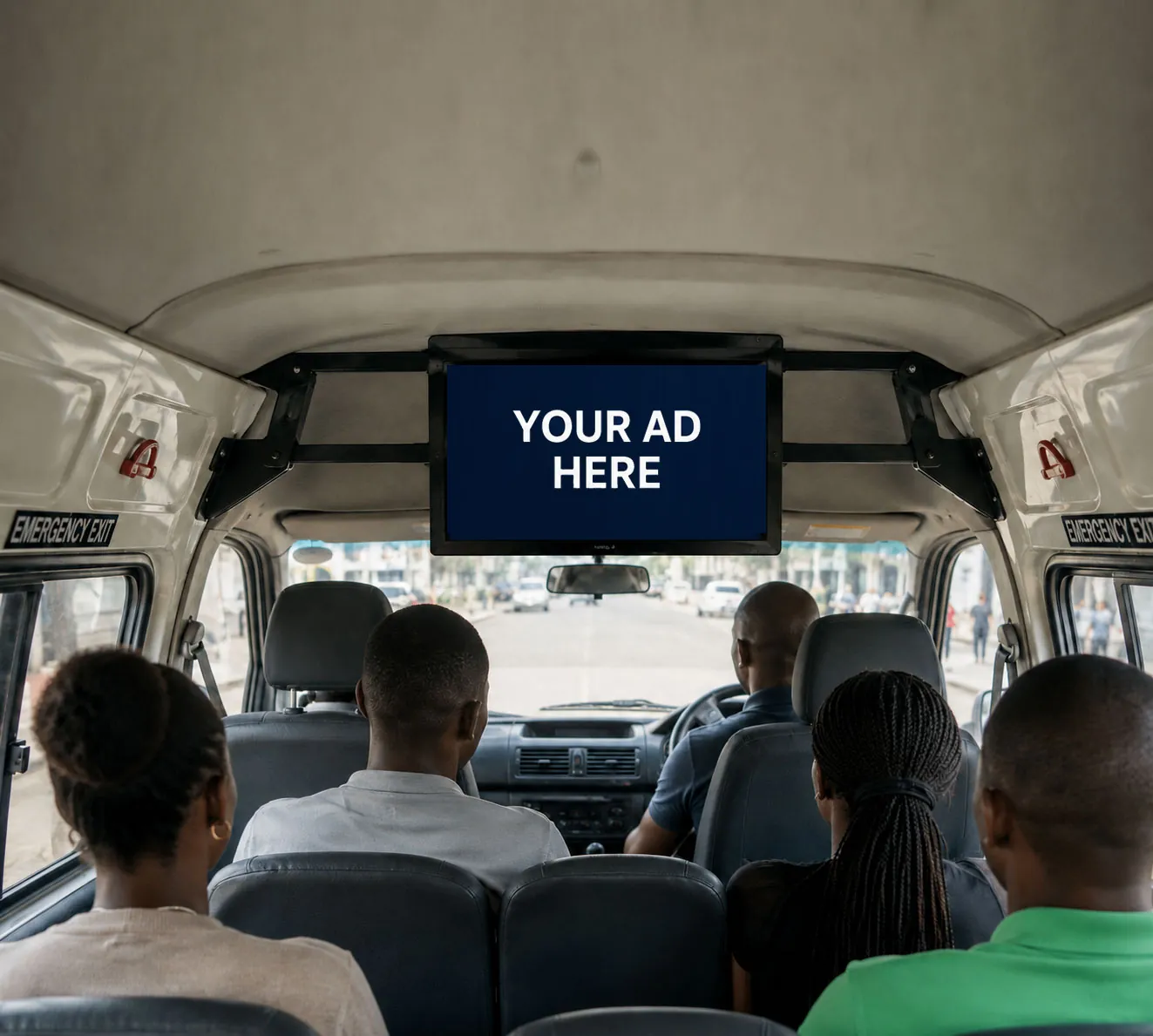
Say 'taxi advertising' to most marketers and they picture a decal on the bonnet or a wrap across the back window. That's a different product with different economics. Momba Media's screens sit inside the taxi, in the passenger's direct line of sight, for the length of the trip.
The screen plays a three-minute loop of 12 advertising slots, 15 seconds each, repeating throughout the day. Nobody chooses to watch it the way they'd choose a video online, they're seated, the screen is a few metres away, and it's simply there for the journey.
Advertising shown on HD screens fitted inside minibus taxis, played as video or static artwork through a continuous loop while passengers travel. It suits brands wanting repeated exposure to a seated, captive commuter audience, rather than a single glance in passing traffic.
The network runs on 400 taxis fitted with HD screens across eight of South Africa's nine provinces, from Gauteng and KwaZulu-Natal down to the Western Cape. Screens are 22-inch in seven provinces and 17-inch in the Western Cape, sized to the vehicles used on those routes.
That footprint matters because taxis are where township, urban and peri-urban commuter traffic actually concentrates, in a way a highway billboard or a shopping centre screen doesn't. Choosing provinces and routes means choosing where an ad sits inside people's actual daily movement, not just where it happens to be visible.
22-inch HD screens
17-inch HD screens
It's effective because of who's in the taxi and how long they stay there, not because the screen is clever. A seated commuter with nowhere else to look for fifteen minutes or more is a stronger prospect for recall. That beats someone walking past a billboard or scrolling past a banner ad.
The bigger correction Momba Media makes with new clients is about the audience itself, not the format. 85% of South Africa's workforce travels by taxi, and that's the fact that tends to change a client's mind about this channel once they hear it.
The minute we mention to them that, oh, by the way, 85% of the workforce of South Africa travel by taxi, then they get to remember, and that's when they wake up.
There's a related misconception worth correcting too, that this audience is lowest-income and can't afford what's advertised. It's a misconception that passengers are lowest LSM, that they're poor and can't afford things. In fact a majority of them work in banks or for the biggest companies, alongside students who'll be the country's future decision-makers.
For buyers who want to check that for themselves, the audience numbers aren't proprietary. They can be found from Statistics South Africa, they're there, available, for anyone who wants to get them.
What actually worries a first-time buyer isn't whether the audience exists, it's whether the campaign will work for their brand specifically. That's answered with reports from campaigns already run, not projections.
Legal Aid SA's in-taxi campaign ran on 57 taxis over 29 days, logging 12,499 completed trips and 1,785,240 ad plays. That gave a frequency of 10.45 views per trip, reaching 129,948 unique people. Morning commute was the strongest window at 540,408 impressions, ahead of evening (399,852) and afternoon (332,609), with the audience skewing 63% male and just over 70% aged 18 to 34.
57 taxis, 29 days, 12,499 completed trips, 129,948 unique people.
Want to see what a campaign report covers before you commit a budget line? We can walk you through one.
Get a Campaign PlanRunning screens inside moving vehicles is its own discipline, not the same job as planning billboards or bus-shelter panels. Creative has to work with the sound off, at a few metres' distance, inside a cabin that's loud and moving. Every piece of content also clears the ARB Code of Advertising Practice before it goes into the loop.
Momba Media operates as the Media Partner of Straat Africa, which puts the screens themselves, their compliance and their upkeep, on a partner built specifically for this. That's different from treating taxi screens as a side product bolted onto a wider outdoor portfolio.
From Brief to Report
Identify the target audience, campaign objectives and geographic priorities.
Select the provinces, routes and taxi network that match those requirements.
Place the creative into the loop and manage scheduling across the chosen network.
The campaign runs across the selected taxis throughout the agreed period.
Track impressions, unique reach, frequency, demographics, hourly and route performance.
Share the results and use them to shape the next campaign.
This format earns its keep for some objectives and not for others, and it's worth saying plainly before anyone books a call.
Price is shaped by five factors, from the advertising space itself to Momba Media's own sales and management costs. None of that reduces to one fixed rate card figure, because a one-province plan looks nothing like a national run.
When budget is the limiting factor, and it usually is, there's no separate targeting formula applied to decide routes. It boils down to calculations in terms of how many taxis we can provide that fit the budget, and the provinces and routes follow from that number.
Media agencies tend to default to wanting national coverage when they first ask, which is a reasonable starting point, but it isn't the only way to spend a budget well. What's included beyond the airtime itself is the planning, route selection, scheduling, compliance checks and the reporting at the end. That means the spend covers the whole campaign, not just the slot.
Whether a media agency books on a brand's behalf or a brand books directly, the process doesn't change, there's no difference. Both get the same planning, the same scheduling and the same reporting at the end.
What shapes the price
Included beyond the airtime: the planning, route selection, scheduling, compliance checks and the reporting at the end.
Momba Media accepts 15-second video in 16:9 HD, up to 300MB, or static HD artwork at 1920 by 1080. That's sized for either the 22-inch screens used in seven provinces or the 17-inch screens in the Western Cape. Once creative is approved and cleared against the ARB Code, it's scheduled into the loop and goes live from the agreed start date.
Yes, local-language creative is supported, and it matters because this is a multilingual, majority Black audience that will not respond to an ad that only speaks to it in English. A straight translation of a national TV ad tends to underperform something written for the audience it's actually reaching. It's worth treating as a proper rewrite rather than a subtitle pass.
A single short flight in one province isn't a fair test of this format. The recall it's built on comes from frequency and repetition, not one pass through a loop. A campaign needs enough weeks and enough frequency for an audience to actually see it more than once before its reach and frequency numbers mean anything against the brief.
Every piece of content is checked against the ARB Code of Advertising Practice before it goes into the loop. The screens themselves also meet national and provincial transport and safety standards. Categories such as alcohol, gambling and financial services are handled with extra care, partly because a meaningful share of commuters during school peak hours are under 18.
Yes, this format typically sits alongside radio, digital and billboard in a media plan rather than replacing any of them. Its usual job in that mix is adding frequency and reach into the commuter and township audience that those other channels don't always reach as efficiently on their own.
A straight comparison of both creative formats on the In-Taxi TV network, so you can brief the right one first time.
Compare the formatsMomba Media plans, schedules and installs video banner advertising across a managed out-of-home screen network reaching commuters throughout South Africa.
See video banners
Everywhere Your Audience Goes.
Connecting Brands with South Africa's Workforce. Every Journey. Every Day.
Add to preferred sources
A quick stop for cookies
We use cookies to see how people find our site and which pages help them, so we can keep improving it. Accept them, or decline and carry on browsing. Your call. Cookie policy
Brochure · PDF
Tell us who you are and the brochure is yours to download straight away.